Because of my job at INGV, where I am involved in the major EPOS European Project, I spend a lot of time reading papers, blog posts, and other resources, not to mention discussing with great colleagues, all dealing with the central subject of system interoperability.

Actually, the real topic for me is interoperability, whose meanings vary across the fields of knowledge, and life, in which we use the concept. In the social sciences we may call it interculturality or interculturalism. In economics, we might call it price, the mechanism that enables exchange of goods. But that is another story, and I think the idea is clear.
Some more concrete interoperability-related topics I deal with include microservices and everything related to web services. Web services are one of the main concepts, and technologies, that enable system interoperability.
RESTful web services are now widely used. They basically rely on HTTP, are reasonably human-readable, and are certainly machine-understandable. Their main advantage is ease of use. In the following example, by copying and pasting the URL into your browser, you access a free weather service through a RESTful API request:
http://api.openweathermap.org/data/2.5/weather?q=London,uk
You then receive a somewhat unusual but fairly human-readable response, perhaps with a few line breaks, telling you what the weather is like in London. Just for fun, here is a list of public RESTful API providers. By the way, Facebook and Twitter require you to be logged in to use their RESTful APIs.
When creating a RESTful web service, it is useful to know that it can reach different degrees of maturity depending on how much it exploits the power of HTTP.
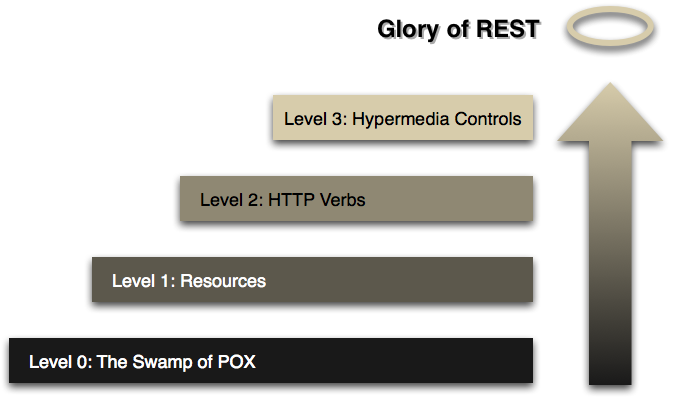
These different levels of maturity were modeled by L. Richardson in the Richardson Maturity Model, which is well described and analyzed in this excellent post by Martin Fowler.
According to this model, a RESTful service can be graded from 0 to 3, where 3 designates a truly RESTful API. In Martin Fowler’s words,
Richardson Maturity Model provides a good step by step way to understand the basic ideas behind restful thinking,
and what is really interesting is
its relationship to common design techniques.
- Level 1 tackles the question of handling complexity by using divide and conquer, breaking a large service endpoint down into multiple resources
- Level 2 introduces a standard set of verbs so that we handle similar situations in the same way, removing unnecessary variation
- Level 3 introduces discoverability, providing a way of making a protocol more self-documenting.
Reading the full article helps you become more familiar with HTTP concepts and understand the real nature of HTTP. I was also surprised by the power and richness of HTTP itself, including verbs and hypermedia controls. It is a communication protocol that deserves special attention because of its widespread use in so many kinds of communication.
Last but not least, I discovered that Leonard Richardson is quite a unique person: programmer, musician, and writer with a hacker mindset. Have a look at his eclectic website.
Link to the article: Richardson Maturity Model by Martin Fowler.